The Framework
FLUX Theory

In 2024, while discussing a concept from fiction on a beach in Sardinia, a geometric form surfaced that became the seed of FLUX Theory — a framework exploring whether physical constants, particle masses, and molecular properties can be derived from a single geometric axiom.
The theory proposes that reality has a structure beneath appearance, and that this structure is geometric. What began as a teenager tracing the golden ratio over Renaissance paintings became, decades later, a formal attempt to derive the constants of nature from first principles.
The physics is moving toward formal publication. In the meantime, the theory is introduced in a series of essays on Substack, and the interactive models that accompany them live at thefluxtheory.org.
The Application
FluxMateria
FluxMateria is the commercial application of FLUX Theory: deterministic molecular and materials computation built for speed, interpretability, and practical use. Where conventional molecular simulation relies on approximation and brute-force computation, FluxMateria computes molecular properties from geometry directly.
A single physics framework with zero fitted parameters and no model training. The FLUX Physics Engine delivers deterministic results — same input, same version, same output — across life sciences, materials science, and chemistry, at speeds up to 3,600,000 times faster than traditional density functional theory.
Ten specialised modules spanning ADMET profiling, target engagement, band gap screening, mechanism discovery, spectroscopy, synthesis planning, and more — all from one coherent physics engine.
The Written Word
The Books
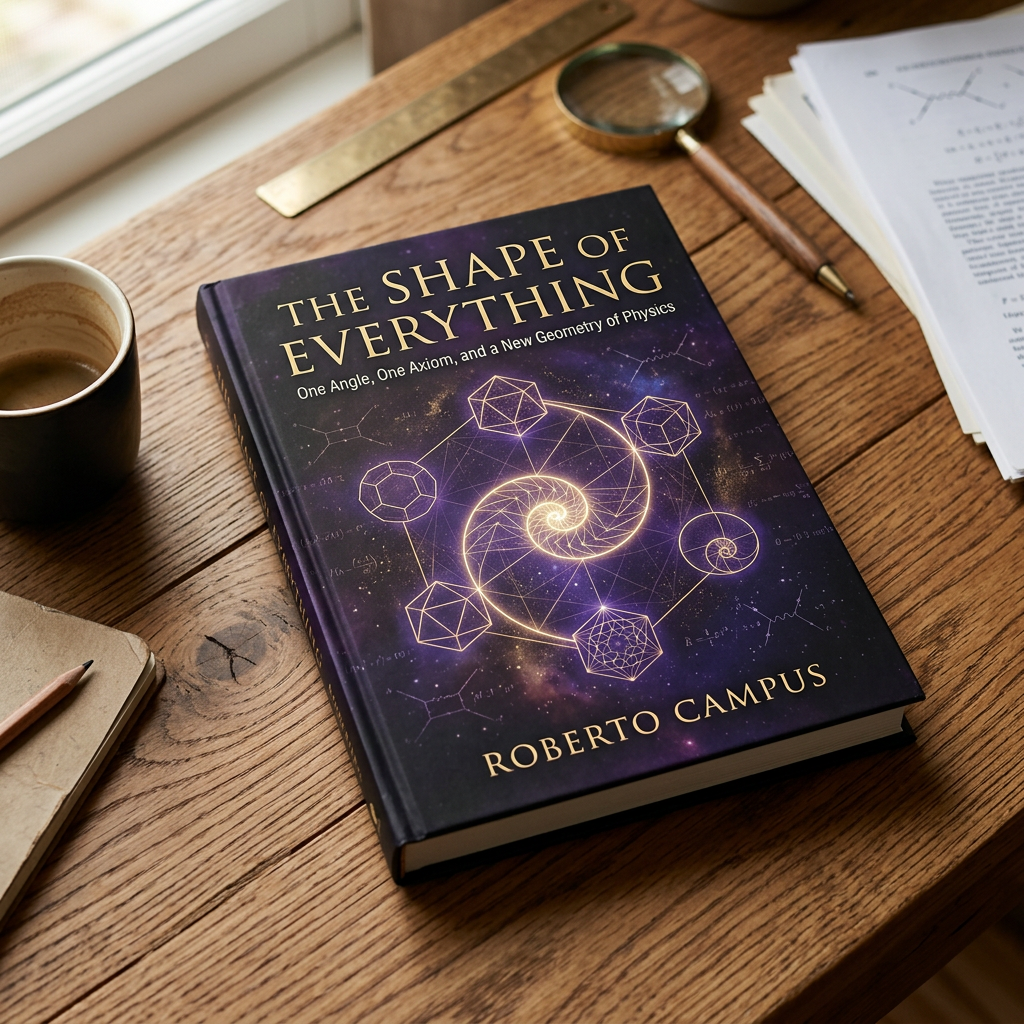
What if the universe isn’t built from particles and forces — but from geometry? What if the constants of nature aren’t arbitrary numbers to be measured, but inevitable consequences of a single shape?
The Shape of Everything presents a radical reimagining of physics from the ground up. Beginning with a shape drawn in the sand on a Sardinian beach, it traces a geometric framework that derives the mass of the electron, the fine-structure constant, the gravitational constant, and the Hubble expansion rate — not fitted, not approximated, but derived from one axiom.
This is not a book about what we know. It is a book about what we have been afraid to ask — and what happens when someone finally does. Every derivation is backed by open-source code you can verify in ten minutes.
One angle. One axiom. Run the numbers.
Coming soon.